
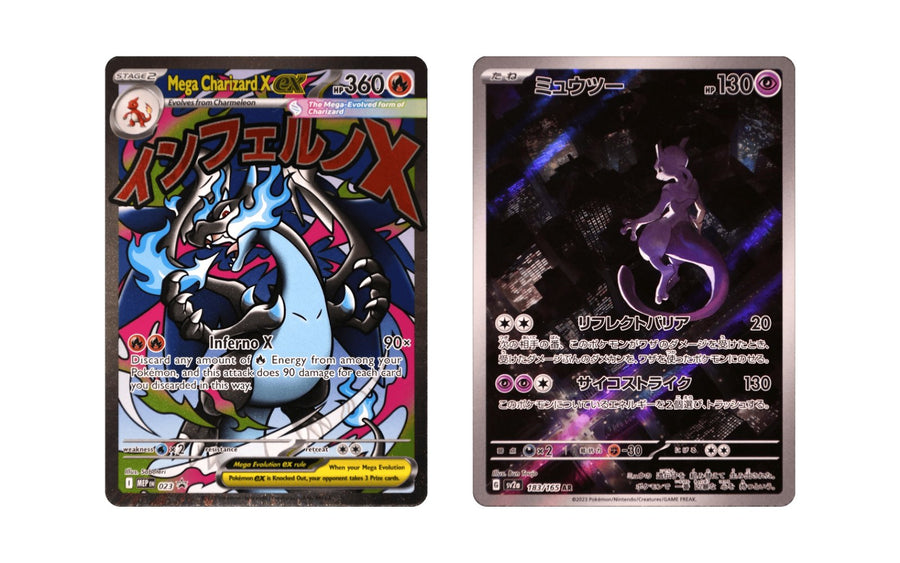
Most Pokémon cards are worth pennies. A few are worth hundreds of euros, and a handful have topped a million dollars at auction. The difference isn't luck or age on its own: it is a mix of rarity, condition, language and demand that you can learn to read.
Here we explain how a card's value is worked out, how to check its real price on Cardmarket and which are the most expensive cards ever sold.
What determines a Pokémon card's value
1. Rarity
This is the first filter. A common or uncommon from a modern set is almost never worth more than a few cents. Value concentrates in the high rarities: in the current era, Illustration Rares (IR), Special Illustration Rares (SIR) and gold Hyper Rares. In Japanese, their equivalents are AR, SAR and UR.
If the abbreviations aren't clear, we explain them one by one in Pokémon and One Piece rarities.
2. The Pokémon (and the artwork)
Two cards of the same rarity can be worth very different amounts. Pikachu, Charizard, Umbreon, Gengar, Mewtwo or Rayquaza always sell above average, and a particularly beautiful illustration can multiply the price. Rarity opens the door; the Pokémon and the art decide how far.
3. Condition
A card with white corners, a scratch on the holo or off-centre printing loses a lot of value. Cardmarket grades condition like this, from best to worst:
| Condition | What it means |
|---|---|
| Mint (M) | Perfect, without a single mark. |
| Near Mint (NM) | Almost perfect. Normal for a card fresh from the pack and sleeved. |
| Excellent (EX) | Small marks visible when you look closely. |
| Good (GD) | Clear wear on edges or surface. |
| Light Played (LP) | You can tell it has been played. |
| Played (PL) | Heavily used. |
| Poor (PO) | Damaged: creases, tears, stains. |
4. Grading (PSA, CGC, BGS)
Grading a card means sending it to a company that assesses it, gives it a score from 1 to 10 and seals it in a rigid case (slab). The best known are PSA, CGC and Beckett (BGS). A card graded 10 can be worth several times the same card ungraded, because that grade certifies it is genuine and in perfect condition.
Grading costs money and isn't worth it for every card: only when the card has real base value and is genuinely in excellent condition.
5. Language
The same card can have very different prices in Japanese, English or Spanish. There's no fixed rule: sometimes the Japanese version is cheaper because it came out earlier and in larger numbers, and sometimes it is the most wanted for its finish. Always compare the card in the exact language you have. If you're torn between languages, we cover it in Japanese or English cards.
6. Demand (and competitive play)
A card that sees a lot of tournament play goes up in price even if it isn't especially rare. And vice versa: when it rotates out or stops being used, it can drop. For collector cards, demand depends on the Pokémon, the artist and trends.
How to find out what your card is worth on Cardmarket
Cardmarket is Europe's reference marketplace and the most useful place to price a card. Steps:
- Search for the card by name and, above all, check the set and number (the one at the bottom, like 199/165). There are many versions of the same card.
- Filter by language and condition. An English Near Mint and a Spanish Played are worlds apart.
- Look at the price data: the lowest available price, the trend and the average of recent days. The lowest price may be a one-off deal or a card in poor condition; the trend and average better reflect what people are paying.
- For graded cards, look for real sales of that card with that exact grade. A PSA 10 and a PSA 9 can be worth very different amounts.
Remember that the asking price isn't the selling price. What someone asks isn't what someone pays.
The most expensive Pokémon cards ever sold

These are some of the most famous sales, with their source. They are dollar figures from specific auctions, not the value of any copy of that card.
| Card | Grade | Price | Sale |
|---|---|---|---|
| Pikachu Illustrator (1998 Japanese promo) | PSA 10 | $16,492,000 | Goldin, 16 February 2026 |
| Snap Charmander, Japanese 64 Mario Stadium promo (1999) | PSA 8 | $640,500 | Goldin, auction closed 10 August 2026 |
| 1st Edition holo Charizard, English Base Set (1999) | PSA 10 | $550,000 | Heritage Auctions, 2025 |
| 1st Edition holo Charizard, English Base Set (1999) | PSA 10 | $420,000 | PWCC, March 2022 |
The Pikachu Illustrator is the most expensive Pokémon card ever sold, according to Guinness World Records. It was awarded in 1998 to the winners of an illustration contest in the Japanese magazine CoroCoro, and very few copies exist. The one in the table belonged to YouTuber and wrestler Logan Paul, who had bought it in 2021 for $5,275,000; in February 2026 he sold it at Goldin for $16,492,000 including buyer's premium.
The 1st Edition Charizard from the Base Set is the great icon of the classic era. A PSA 10 copy going from $420,000 in 2022 to $550,000 in 2025 shows how much the perfect grade matters: the same card in worse condition is worth a fraction of that.
Why modern SIRs and SARs are so sought after


You don't need to go back to 1999 to find expensive cards. In current sets, Special Illustration Rares (SIR) and their Japanese equivalent, SAR, are what move the market, for several reasons:
- They are hard to pull. They appear in very few packs per box, sometimes fewer than one.
- The art covers the whole card. They are small illustrated scenes, often of the Pokémon in its habitat or with its Trainer.
- They combine collecting and play. Many SIRs are versions of Pokémon ex used in tournaments, so they have two audiences.
- Popular Trainers sell a lot. SIRs of beloved characters are often among the most expensive cards in their set.
Their price changes a lot in a set's first months: it is usually high at launch and settles as more boxes are opened. If you're after a specific one, buying it as a single is almost always better than opening packs until it shows up.
Before selling or buying an expensive card
- Check it's genuine. Fakes target precisely the most expensive cards. We explain how to spot them in how to tell if a card is fake.
- Check the condition in good light, front and back. Corners and back edges are the first to show wear.
- Check the price the same day. The prices in this article are from the dates shown and the market moves fast.
- Sleeve the card as soon as you pull it. A soft sleeve and, if it's valuable, a rigid sleeve or toploader.
In our Pokémon singles every card has its own real photos, so you can see the exact condition of the copy you buy. And if you'd rather try your luck, there are packs in Pokémon packs.
Keep reading
- Rarities explained: IR, SIR, SAR, UR and the rest.
- How much a Pokémon or One Piece pack costs.
- How much One Piece cards are worth and which are the most expensive.
Pokémon card images: © Pokémon / Nintendo / Creatures / GAME FREAK. ONLYCHASES is not affiliated with The Pokémon Company.
Try it in ARENA, for free
ARENA is a free One Piece Card Game simulator in your browser: ranked league, private rooms with friends, online Swiss tournaments and an AI to practise against. Official rules and every card.
Play free in ARENA

