
Pokémon TCG looks complicated the first time you watch a game: turned cards, damage counters, people taking Prize cards. In reality the basics can be learned in an afternoon. Here are the essential rules for your first game, explained in order and without unnecessary jargon.
The rules we summarise are those of The Pokémon Company's official rulebook. If a card ever says something different from the general rule, the card wins.
What you need to play
- A deck of exactly 60 cards, with at least one Basic Pokémon.
- No more than 4 copies of a card with the same name. The only exception is basic Energy, which you can include in any quantity.
- A coin (or a die) and something to track damage: counters, small dice or an app.
A deck has three kinds of cards:
| Type | What it does |
|---|---|
| Pokémon | They do the fighting. There are Basic Pokémon, which are played directly, and evolutions (Stage 1 and Stage 2), which are placed on top. |
| Energy | Attached to your Pokémon so they can attack and retreat. |
| Trainer | Items, Supporters, Stadiums and Pokémon Tools: they draw cards, heal, search for Pokémon or change the pace of the game. |
Setting up the game
- Each player shuffles their deck and draws 7 cards.
- If you have no Basic Pokémon in your hand, show it, shuffle it back and draw another 7. This is a mulligan, and your opponent may draw one extra card for each one you take.
- Place a Basic Pokémon face down as your Active Pokémon and, if you like, up to 5 more Basic Pokémon on your Bench.
- Put the top 6 cards of your deck face down to one side: these are your Prize cards.
- Flip a coin to decide who goes first, turn the Pokémon face up and the game begins.
Active and Bench: how the table is laid out
Only the Active Pokémon attacks and is attacked (unless a card says otherwise). The Bench is the sidelines: up to 5 Pokémon waiting, building up Energy or evolving. If your Active Pokémon is Knocked Out, you choose one from the Bench to take its place.
You can switch your Active Pokémon by retreating it: discard as many Energy from that Pokémon as its Retreat Cost shows and swap it with one from the Bench. Only once per turn.
How a turn works
Each turn has three parts:
- Draw a card. This is mandatory. If you have no cards left in your deck at the start of your turn, you lose.
- Take actions, in any order:
- Put Basic Pokémon on your Bench.
- Evolve Pokémon (once per Pokémon per turn, and never on the turn it came into play).
- Attach one Energy from your hand to one of your Pokémon. Only one per turn.
- Play Trainer cards: as many Items and Pokémon Tools as you like, but only one Supporter and one Stadium per turn.
- Retreat once.
- Use Abilities, as each card says.
- Attack. Attacking ends your turn. It isn't mandatory: you can pass without attacking.
Watch out on the first turn: the player who goes first can't attack or play a Supporter on their first turn, and nobody can evolve on their first turn.
How attacks work
Each attack shows which Energy it needs. If your Active Pokémon has the required Energy attached, it can use it. Damage is tracked with counters: each counter equals 10 damage. When the damage equals or exceeds the Pokémon's HP, it is Knocked Out and goes to the discard pile with everything attached to it.
Each time you Knock Out one of your opponent's Pokémon, you take Prize cards:
| Pokémon Knocked Out | Prize cards you take |
|---|---|
| Regular Pokémon | 1 |
| Pokémon ex | 2 |
| Mega Evolution Pokémon ex | 3 |
That's why Pokémon ex and Mega ex are as powerful as they are risky: they hit harder, but they give away more Prize cards.
Weakness and Resistance
At the bottom of each card you'll see its Weakness and Resistance, if it has any:
- Weakness: if the attacker is of the type shown, the damage is multiplied (usually ×2).
- Resistance: if the attacker is of the type shown, the damage is reduced by the printed amount (usually −30).
They only apply to the Active Pokémon, not to Benched ones.
How to win a game
There are three ways to win:
- Take all 6 of your Prize cards. The most common way.
- Leave your opponent with no Pokémon in play: if you Knock Out their Active Pokémon and they have nothing on the Bench to replace it.
- Your opponent can't draw at the start of their turn because their deck has run out.
Special Conditions: the basics
Some attacks leave the opponent's Active Pokémon with a Special Condition. They are shown by turning the card or with a marker, and they are removed if the Pokémon evolves or goes back to the Bench.
| Condition | How it's shown | Effect |
|---|---|---|
| Asleep | Card turned to the left | Can't attack or retreat. Flip a coin between turns: heads, it wakes up. |
| Paralyzed | Card turned to the right | Can't attack or retreat. Recovers after its owner's next turn. |
| Confused | Card turned upside down (180°) | Flip a coin before attacking; if tails, the attack fails and it takes 3 damage counters. |
| Poisoned | Marker | Takes 1 damage counter between turns. |
| Burned | Marker | Takes 2 damage counters between turns, then flip a coin: heads, it recovers. |
Asleep, Paralyzed and Confused replace one another (only the latest counts). Poisoned and Burned can coexist with any of them.
What to buy to get started
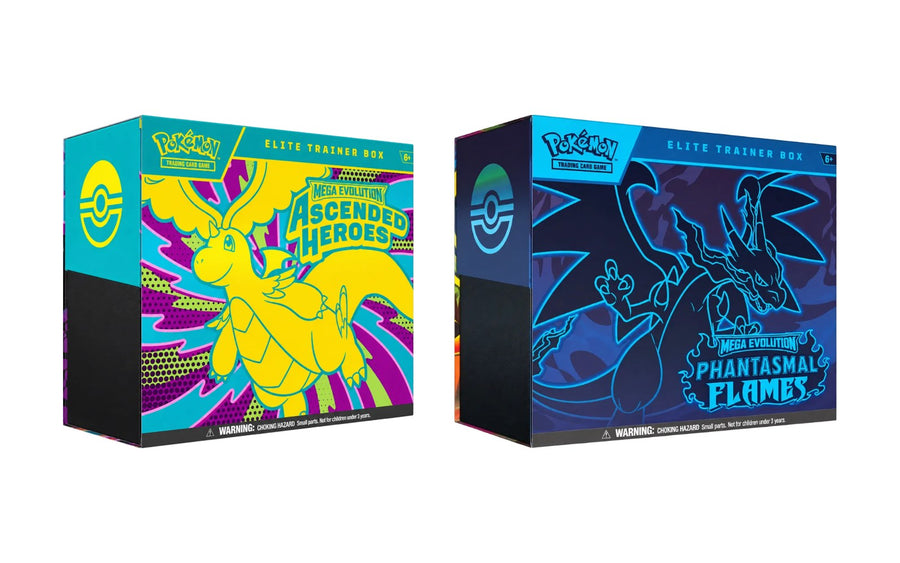
 Ascended HeroesElite Trainer Box · ENView in store
 Phantasmal FlamesElite Trainer Box · ENView in store
 White FlareElite Trainer Box · ENView in store
Don't start by opening packs to build a deck: it's the most expensive and slowest way. There are products designed for learning:
- Battle Deck or League Battle Deck: a 60-card deck ready to play. The most direct option if you want to learn by playing with someone.
- Elite Trainer Box (ETB): comes with packs, 65 sleeves, basic Energy, dice, markers and a guide. It isn't a ready-to-play deck, but it gives you all the material to build one and it's a good buy if you also fancy opening packs.
We compare every format in ETB, Booster Box or single pack, and all the available product is in Pokémon · Sealed product. When you want to fine-tune your deck with a particular card, it's much cheaper to buy it in singles than to open packs until it shows up.
Language: which cards are tournament-legal in Europe
At home you can play with cards in any language. In official Play! Pokémon tournaments in Europe, cards in English, Spanish, French, German, Italian and Portuguese are legal. Japanese cards are not legal in official European tournaments. If you plan to end up playing in a league at your local shop, start with cards in English or your own language.
We go into more detail in Japanese or English cards: which to buy.
Tips for your first games
- Play a ready-made deck several times before changing cards. You'll understand why it's built that way.
- Attach an Energy every turn, even if you don't need it yet. It's the most common beginner mistake.
- Don't leave your Bench empty. If your Active Pokémon falls and you have nothing behind it, you lose the game.
- Read the card. If a card's text contradicts a general rule, the card wins.
Keep reading
- ETB, Booster Box, bundle or single pack: what each format includes.
- Japanese or English cards: price, quality and tournaments.
- Pokémon and One Piece rarities: what IR, SIR and the rest mean.
And if you're also interested in the One Piece game, its guide is in how to play One Piece Card Game. Our whole Pokémon catalogue is in Pokémon.
Try it in ARENA, for free
ARENA is a free One Piece Card Game simulator in your browser: ranked league, private rooms with friends, online Swiss tournaments and an AI to practise against. Official rules and every card.
Play free in ARENA

